Tuesday, 25 September 2012

IRRI DG Zeigler meets with Indian agriculture minister

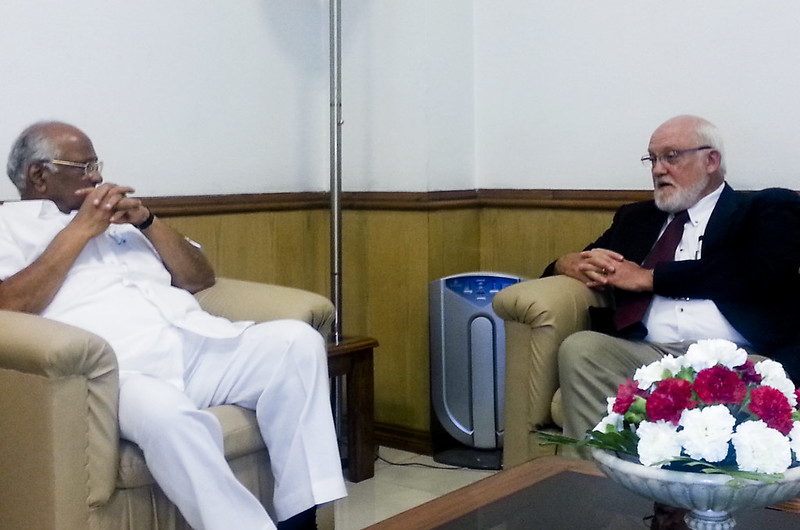
IRRI DG Bob Zeigler (right) meets with Indian Agriculture Minister Sharad Pawar.

During his recent visit to India, IRRI Director General Robert Zeigler had an audience with Minister of Agriculture Sharad Pawar, during which he apprised the minister of recent developments in rice research at IRRI and the support extended by IRRI to the Government of Assam during a recent flooding in the state.

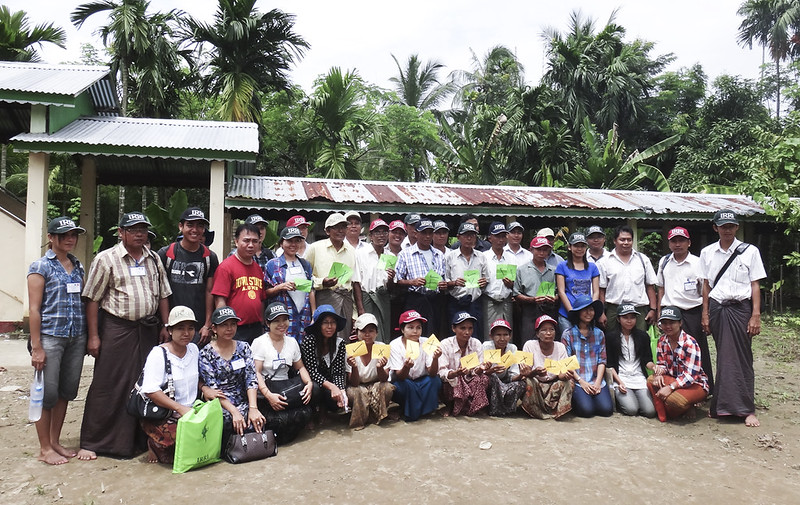
Myanmar: Training held on participatory variety selection for the Lower Ayeyarwady Delta


A training course on participatory variety selection or PVS was conducted in the Labutta (13-15 September) and Bogale districts (18-20 September) in the Ayeyarwady Delta of Myanmar.

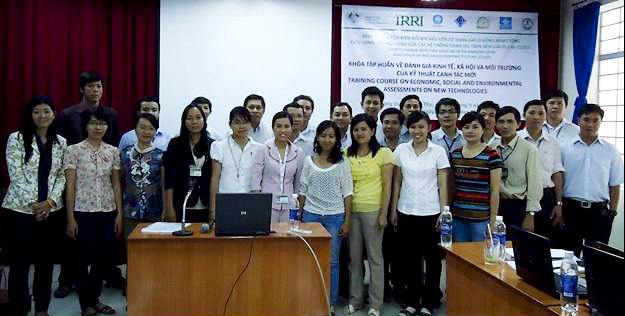
Vietnam: CLUES project holds workshop on assessment of new technologies


A workshop, Economic, social and environmental assessments of new technologies, was held on 19 September 2012 at Can Tho University (CTU) in Vietnam, attended by 25 technical staff of the CLUES Project from Cuu Long Delta Rice Research Institute and CTU.
Professor Le Quang Tri, national project director, said in his opening message that providing added knowledge and tools on socioeconomics are crucial to the CLUES Project attaining its objectives.
Topics covered in the workshop were:
  • Simple economic analysis tools like partial budgeting analysis and economic inefficiency analysis
  • Survey methods and data generation for technology assessment
  • Cost-benefit analysis
Also introduced during the workshop is DREAM, or Dynamic Research EvaluAtion for Management software, and its applications for economic analysis of technology impact assessment.

Vo Thanh Danh, dean of the School of Economics and Business Administration at CTU, was resource speaker.

The workshop was organized by Theme 4 of the CLUES Project.


Learn more about IRRI (www.irri.org) or follow us on the social media and networks (all links down the right column).

Philippines: Postharvest Learning Alliance helps farmer groups develop business plans

Al Schmidley, IRRI business model specialist,
says that farmers can be very innovative when enabled.
The Sto. NiƱo Multipurpose Cooperative (SPMC) and the Taguibo Farmers’ Irrigators Association hosted working meetings in Agusan to develop business plans for postharvest enterprise activities, with support from the Postharvest Learning Alliance and Caraga State University.


The goal of the meetings was to enable farmer groups to develop their own business plans for piloting or expanding their postharvest activities as entrepreneurial enterprise models. Two particular areas identified, for which business plans are being developed by the farmer groups, were mechanical drying of farmers’ paddy and use of rice by-products.

Gertrudes Fortun, agriculturist from Butuan City, expressed hope that the farmer groups will use the business plan tool to attract resources for adoption of improved postharvest technologies, such as mechanical dryers.

Plenio Atega, SMPC president, explained that, during the wet season, harvested paddy "often remain covered too long on sun-drying platforms during extended rainfall, sometimes even germinating before we can dry it for milling." The result is very low-quality paddy and milled rice, and farmers like him lose a lot of money as a result.

At the Taguibo Irrigators Association, President Romy Lasco had a similar concern. “Our farmers can lose at least 30% of the crop due to lack of drying facilities during the wet season. Traders then discount the equivalent of 5 kilograms off the price out of every 50 kilograms due to low paddy quality, and farmers lose another 10%.”

Professor Raquel Balanay, an economist from Caraga State University, and Alfred Schmidley, business model specialist for IRRI, advised the farmers’ groups on the use of a business plan.

“During the meetings, we examined the business case for offering mechanical drying services to farmers but discovered many other interesting enterprise activities that these farmers are engaged in," shares Dr. Balanay. "For example, both farmers groups recently began vermiculture and organic fertilizer enterprises that usepostharvest by-products such as rice hull, rice stalks, and coconut husk fiber. They mix these with livestock manure to form high-nutrient compost, a product that helps farmers decrease input cost while allowing their organizations to sustain themselves by selling higher-margin value-added products. The Taguibo group is now looking at setting up a small shop in Butuan for selling vermiculture products, compost, and farmer-produced organic food items."
 
“Farmers, when properly enabled, can be very resourceful and innovative,” Mr. Schmidley observed. “The business plan tool can help them analyze the business case for new technologies, expand profitable enterprise activities, or attract additional resources and capital.”

The next step for the Postharvest Learning Alliance is to host a multi-stakeholder meeting in November where farmer groups, microfinance institutions, rural credit cooperatives, and other groups can learn more about postharvest enterprise opportunities.


Learn more about IRRI (www.irri.org) or follow us on the social media and networks (all links down the right column).

Philippines: Cordillera farmers and extension workers learn to document activities


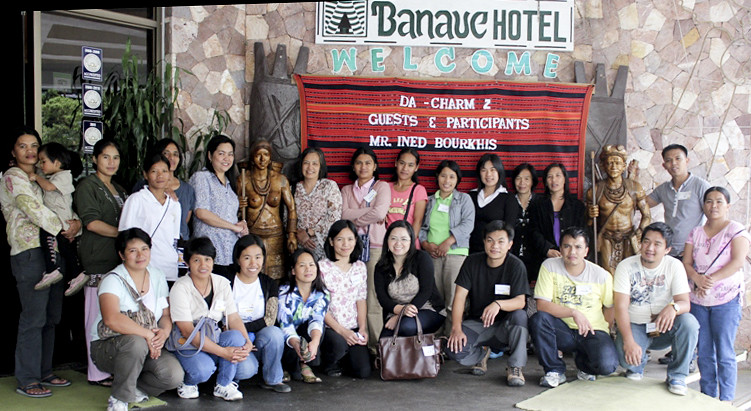
Twenty-four farmers and extension workers from the Cordillera Region in Northern Philippines were participants in a workshop on documentation of participatory activities, organized by the Consortium for Unfavorable Rice Environments (CURE).


"The workshop is part of a linkage that CURE had built with IFAD investment projects, called 'technical innovation service' or TIS," explains Digna Manzanilla, IRRI social scientist and CURE associate coordinator.

The Consortium entered into a partnership in early 2011 with the IFAD-funded Second Cordillera Highland Agricultural Resource Management Project (CHARMP2). The documentation workshop is part of the series of activities lined up for farmers and extension workers from the project's three pilot villages—Hungduan in Ifugao, Barlig in Mountain Province, and Pasil in Kalinga.

The workshop's aim is to provide participants with tools for organizing, analyzing, and documenting field-based information. It provided help on writing documentation reports and packaging these into formats that are tailor-fit to the needs and characteristics of specific audiences.

Dr. Manzanilla adds, “The workshop should help our partners understand the importance of drawing lessons from the activities that they implement at the grassroots level, and of sharing these to others, especially other partners and donors.”

The workshop was held on 18-20 September 2012 at Banaue Hotel in Ifugao Province.


Learn more about IRRI (www.irri.org) or follow us on the social media and networks (all links down the right column).